"People just want to get the most money out of it."
— Elizabeth Ingram, as quoted by Winter Park Voice
The comment came in June 2026, minutes after fellow commissioners voted to let a lakefront estate be split in two ahead of what looks like an all but certain demolition. Ingram was talking about Merrywood, the 1939 James Gamble Rogers II design on Lake Osceola. The case raises a broader question about how older homes are preserved in Winter Park.
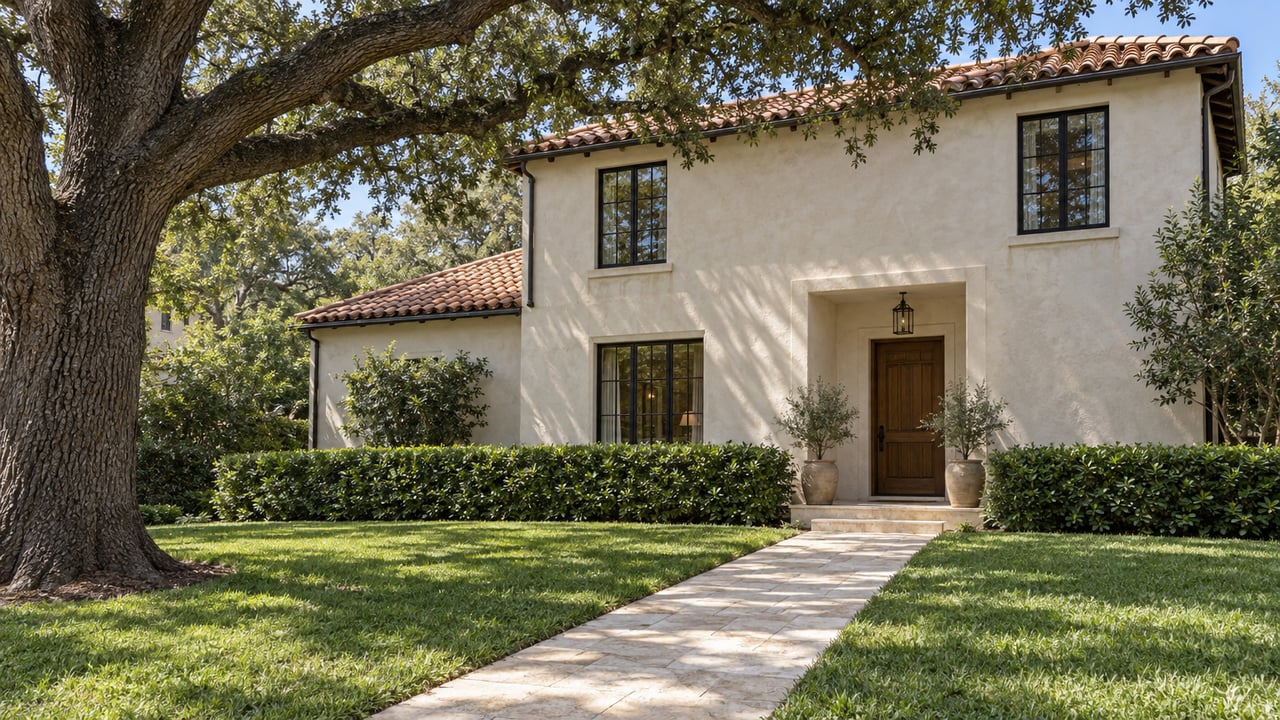
If you're looking at a home in Winter Park with the kind of character that drew you here in the first place, an oak canopy that predates the house, a Spanish eclectic roofline, brick streets and a pedigree architect, it's worth understanding how the city's historic-registration system works. As News 13 reported, registration is voluntary, and the city cannot require an owner to apply.
Voluntary by Design
Winter Park's Historic Preservation Board reviews applications for alterations to designated properties and makes recommendations to the city commission. What it cannot do is force an owner to designate a home in the first place. The City of Winter Park says a property generally has to be at least 50 years old and carry architectural, aesthetic or historical value to qualify; the board leans on National Register of Historic Places criteria as its guide. But qualifying and registering are two different acts.
Casa Feliz and Merrywood illustrate different outcomes for older Rogers-designed homes in Winter Park. Both are James Gamble Rogers II designs. Casa Feliz was saved from demolition roughly 25 years ago after several hundred thousand dollars in donations came together to move and restore it, and it now operates as a public venue. The Burress House, a Tudor-style Rogers design that belonged to the same architect's body of work, was demolished around 2005. Betsy Rogers Owens, whose grandfather designed both homes and who now leads Friends of Casa Feliz, has said fewer than 30 true examples of her grandfather's work remain standing in the city. The city's register is voluntary, and owners decide whether to apply for historic designation.
City leaders asked the Historic Preservation Board this summer to develop incentives that might convince more owners to register voluntarily, and the board has spent its recent meetings working through the options. In August 2026 the board discussed continuing a 50 percent matching grant capped at $18,000 per property along with reduced permit fees. More recently the board has coalesced around exploring transfer development rights, a one-third permit fee reduction, and tax-exemption mechanics for designated properties, with deed restrictions built in to prevent abuse. Those proposals are expected to reach the city commission for a workshop this fall. None of it changes what's true right now for anyone shopping in Winter Park today: registration is optional, and the incentive to opt in is still being built.
The Carve-Out at 1020 Palmer Avenue
Merrywood sits on 3.67 acres of Lake Osceola frontage, the largest lot on the city's Chain of Lakes, and it's the largest residence Rogers ever designed. The house is described as unlivable, with burst pipes, severe leaks and systems beyond repair. A demolition permit is already filed. Under the proposal, the property would be split, with a home site on one half and Merrywood on the other.
Winter Park has rules governing lakefront lot splits. To make this deal work, the city commission amended its comprehensive plan in June, voting 3-2 with commissioners Warren Lindsey and Elizabeth Ingram dissenting. According to WFTV, the amendment allows lakefront parcels over 3.5 acres to split into two lots, each with at least 150 feet of frontage on both lake and street and a minimum size of 1.5 acres. Combined new construction is capped at 30,000 square feet, with a condition that at least one home echo Rogers' style. Commissioner Lindsey had asked planning staff to check how many other lots in the city could even qualify. The answer was three, and only a handful over two acres. With those size and frontage requirements, the amendment applies to very few lakefront lots in the city today.
What makes the case worth knowing about isn't just the vote. Attorney Matt Morgan says he made a verbal offer of $10 million for the whole Merrywood lot last year with the stated intent of preserving it, and reinitiated that offer the week before the commission's first vote. By his account, that offer wasn't included in the information the commission reviewed before it acted. Commissioners who favored the split argued that keeping the lot whole would let a future buyer tear down Merrywood anyway and build something even larger, pointing to the 40,000 square foot Odyssey estate at 926 Palmer Avenue as a comparison and noting the lot could otherwise support a home over 56,000 square feet. Whether you favor preservation or the proposed split, the mechanism is the same one that applies to any older Winter Park property. A property's historic designation is one factor to check when considering its future.
The Trees Carry Their Own Rules
Separate from historic status, Winter Park protects its tree canopy through its own ordinance, and this one applies whether or not a house has any pedigree at all. According to Winter Park's municipal code, a live oak or bald cypress in fair to excellent condition measuring 30 inches or more in diameter is a landmark tree, and landmark trees carry triple the standard mitigation rate along with a requirement to replace each one with six replacement trees.
The ordinance's own example is useful for doing the math on a real project. The City of Winter Park's ordinance gives this example: removing a 24-inch diameter laurel oak, which falls short of landmark status, requires either replanting two 3-inch caliper canopy trees or paying financial compensation at $110 per inch of diameter, working out to $2,640. A landmark oak at 30 inches or more triggers three times that rate on top of the six-tree replacement requirement. On a lot with several mature oaks near where you'd want to build an addition or a pool, that math adds up before a shovel touches the ground.
This isn't hypothetical or limited to estate-scale fights. In August 2026, Winter Park's planning board approved a detached accessory structure at 161 Palmer Avenue with reduced front and side setbacks. As part of that approval, the city's urban forestry staff identified one oak as failing and signed off on removing a 16-inch magnolia and a 24-inch oak, on the condition that both be fully mitigated through the city's tree removal program. It's a small, unremarkable project on the same street as Merrywood and the Odyssey, and it shows the same rule doing the same work at a completely different scale. If you're planning to expand or rebuild on a treed Winter Park lot, this is the process you'll go through too.
Why the ZIP Code Changes the Stakes
Winter Park's two main ZIP codes behave differently enough that the same ordinance carries different weight depending on where you're shopping. In 32789, the Chain of Lakes core that includes Palmer Avenue and most of downtown, typical home values have been running from the high $700,000s into seven figures through 2026, and that's also where you're most likely to find a legacy lot like Merrywood's, with decades of tree growth and an architect's name attached. In 32792, east of downtown, typical values have been running roughly in the $400,000s to $600,000s, with more price reductions and more room for buyers to negotiate.
That gap isn't just about square footage or school zones. It's about what you're actually buying. In 32789, a mature oak canopy or an unregistered Rogers-era home is often a meaningful share of what makes the price defensible, so the tree ordinance and the historic designation gap carry real dollar consequences if you plan to renovate, expand, or eventually sell. In 32792, lots tend to be smaller and homes newer, so the same rules apply on paper but rarely change the deal math as much. If you're comparing a home in each ZIP code, the price difference alone won't tell you which one comes with more redevelopment flexibility and which one comes with more redevelopment risk. You have to ask.
What This Means Before You Write an Offer
A few checks take less than a day and can change how you think about a property's long-term value:
- Ask the city's planning department whether the home or lot is on the Winter Park Register of Historic Places.
- If mature oaks or cypress trees sit near where you'd want to build, ask for a diameter count before you assume you have room to expand.
- Check whether a demolition permit has already been filed on a property you're interested in. It's public information and it tells you where the current owner's intentions actually stand.
- If your plans involve splitting a lakefront lot, know that the Merrywood amendment was written narrowly for one address. Don't assume the same flexibility applies elsewhere on the Chain of Lakes.
- Watch what the city commission does with the Historic Preservation Board's incentive proposals this fall. Whatever passes will change what's financially rational for sellers of older homes near you, which can affect both resale value and what comes up for sale next.
None of this makes an older Winter Park home a bad idea. It makes the price tag an incomplete answer. Its historic designation and any filed demolition permit are worth checking before you make an offer.
If you're weighing an older home in Winter Park for its character, its lot, or its redevelopment potential, Brenda Feliciani can help you check what's actually protected before you write an offer. Request Your Free Home Valuation to start that conversation.
This article is general information, not legal, tax or financial advice. Consult a qualified professional about your situation.